For years, white was the default answer for kitchen cabinets. It was safe, versatile, and virtually everywhere. Then something shifted.
According to the Houzz 2026 Kitchen Trends Study — which surveyed more than 1,700 homeowners actively renovating — wood cabinetry officially overtook white as the most popular cabinet choice for the first time in recent memory. Wood was selected by 29% of renovating homeowners, up six points year over year. White came in at 28%.
That shift is prompting a lot of homeowners to pause and ask: should I be reconsidering my cabinet choice?
The short answer is…not necessarily. White cabinets haven't lost their value — they've simply found a genuine competitor. Both finishes are strong, practical choices that hold up beautifully in the right context. What matters is understanding which one is right for your specific kitchen, lifestyle, and goals. That's exactly what this guide will help you figure out.
Why Are Wood Kitchen Cabinets So Popular Right Now?
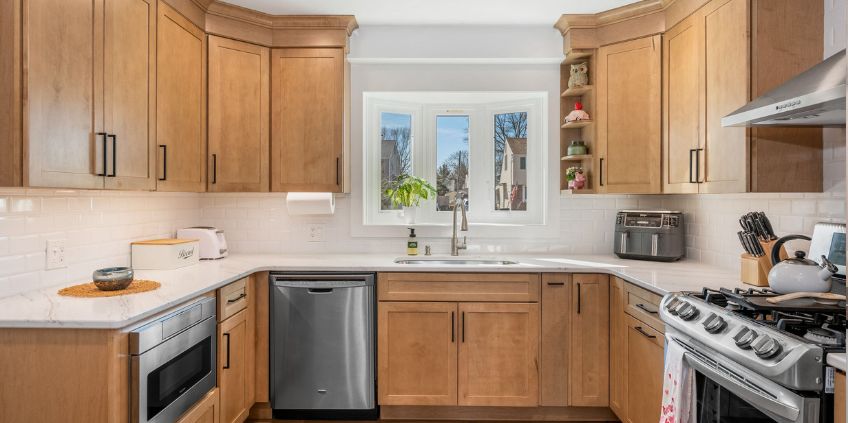
The move toward wood reflects a broader shift in how homeowners want their kitchens to feel. After years of all-white interiors that looked pristine in photos but sometimes felt a little cold in person, there's been a growing appetite for spaces with more warmth, texture, and personality.
Reico White Plains team member Kemani Good has seen the shift firsthand. "Whites are definitely fading out. We've seen it a million times, it's becoming more of the "safe" option. The natural wood and warm tones are just so cozy and aesthetically pleasing."
Wood cabinets bring a quality that white finishes can't fully replicate — natural grain variation, depth, and the kind of warmth that makes a kitchen feel genuinely lived-in rather than just designed. The way wood stain responds to natural light throughout the day is a big part of the appeal, and it's something that tends to surprise homeowners who haven't experienced it firsthand.
29% of renovating homeowners chose wood cabinets in 2026 — up 6 points in a single year. — Houzz
Medium wood tones are the most popular choice of the moment, selected by 15% of renovating homeowners, followed by light wood at 11% and dark wood at 3%. Among species, white oak has become the standout favorite. White Oak is appreciated for its subtle gray undertones, tight grain pattern, and ability to work in both modern and transitional kitchens. Walnut skews richer and more dramatic, making it a natural fit for upscale or moody interiors. Maple remains a clean, budget-friendly option with a consistent, fine-grain look that works well in contemporary spaces.
The broader data reinforces the shift: painted cabinets overall dropped from roughly 70% of the market to 52%, according to Woodworking Network — a meaningful change driven largely by the return of natural wood finishes.
Are White Kitchen Cabinets Going Out of Style?
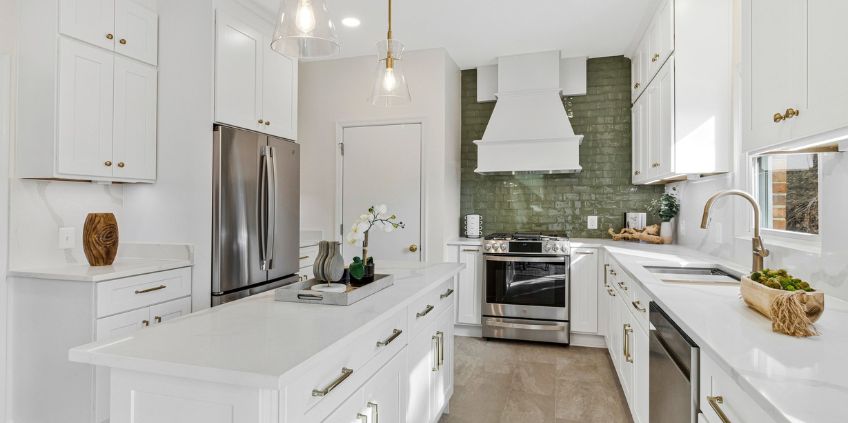
White cabinets are not going anywhere. The data shows white still holds 28% of the market — a strong showing. The shift toward wood is more of a gradual evolution than a revolution. What is changing is the type of white homeowners are reaching for.
The cool, stark whites that dominated kitchens in the early 2010s have largely given way to creamier, warmer tones. Shades like Benjamin Moore White Dove, Sherwin-Williams Alabaster, and soft linen whites feel more inviting, pair better with natural materials, and hold up more gracefully as design preferences evolve. Even if you love white kitchens, these warmer versions are well worth exploring.
White also remains the preferred choice in some specific situations:
- Smaller kitchens where light and airiness are the priority
- North-facing kitchens with limited natural light
- Homeowners prioritizing broad resale appeal in the near term
- Anyone who loves a clean, backdrop-style kitchen that lets other design elements — artwork, plants, colorful appliances — take center stage
It's also worth noting that in two-finish kitchens, white (or other warmer shades) remains the dominant choice for upper wall cabinets, appearing in 40% of those installations. White is evolving, not disappearing.
Reico Charlottesville team member Azurae Burdett shared,"off-white cabinets mixed with warm wood finishes make kitchens feel welcoming and balanced. The natural wood brings cozy warmth and texture. The off-white finishes make the room feel brighter, cleaner, and more open. I think this is a great combo that looks stylish and modern, but comfortable and lived in."
Wood Cabinets vs. White Cabinets: Full Comparison Guide
Here's how the two options stack up across the dimensions that matter most to homeowners making this decision:
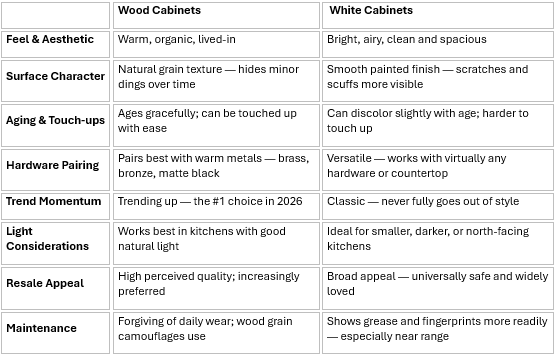
See Reico's wood and white cabinet finishes side by side — Visit our kitchen gallery!
Can You Mix Wood and White Cabinets in the Same Kitchen?
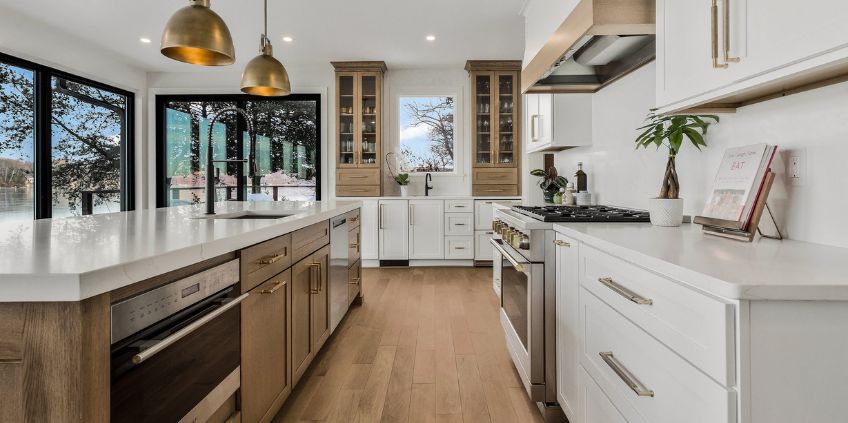
If you find yourself drawn to both options, you're in good company. Nearly 1 in 4 homeowners now choose two-finish kitchen designs that incorporate both wood and white in the same space. It's one of the more versatile approaches available for homeowners who want warmth without giving up brightness.
The most common combination is white or off-white upper cabinets paired with wood lower cabinets or a wood island. The reasoning is straightforward: upper cabinets stay light and open, which keeps the room from feeling heavy, while the lower cabinets and island introduce warmth and a grounded, natural quality at eye and counter level.
1 in 4 homeowners now choose a two-tone or two-finish kitchen in wood and white, pairing white uppers with wood lowers for the best of both finishes. — Houzz
The two-finish approach also gives homeowners who are on the fence a practical middle ground. In a poll of Reico experts, 66% indicated that customers are giving strong consideration to combining finishes when it comes to cabinet selections. The key to making it work is consistency: use the same door profile in both finishes, keep your hardware uniform throughout, and make sure your countertop selection ties the two cabinet colors together rather than competing with them.
"We have a lot of clients wanting a warm cozy feel for their home and mixing a lighter paint with a stain seems to be a perfect solution. Plus, it works with many trends/styles making it versatile and you can accessorize it with warm or cool tone hardware, stones and textiles," said Reico Annapolis team member Ashley Ferguson
How Do I Choose the Right Cabinet Finish for My Kitchen?
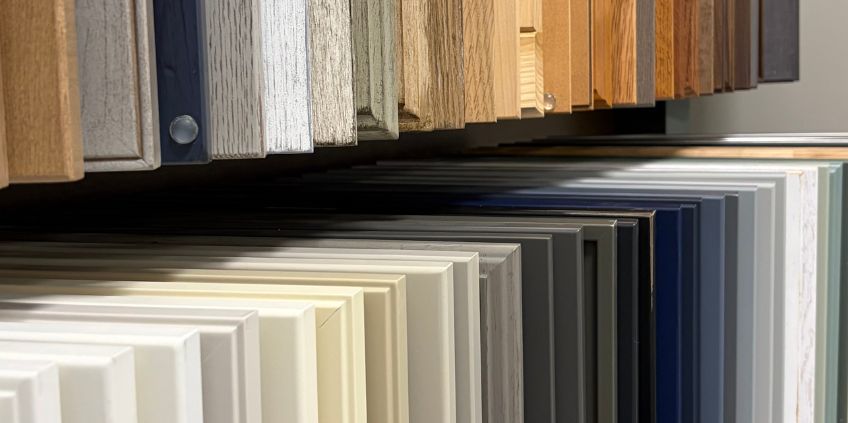
Sometimes the best way to cut through the noise is to answer a few direct questions about your own kitchen and how you use it. Work through these five — they tend to bring a lot of clarity:
Q1 How much natural light does your kitchen get?
This is often the most telling factor. A well-lit, south-facing kitchen with generous windows can handle wood beautifully — the warmth of the finish reads as inviting rather than heavy. In a darker or north-facing kitchen, white cabinets do real work: they reflect available light and make the space feel more open. If your kitchen doesn't get a lot of natural light, white is usually the more comfortable long-term choice.
Q2 What countertop material are you working with — or planning to use?
Marble and quartz work well with both finishes. Butcher block has a natural affinity with wood cabinetry and creates a cohesive, warm look throughout. Dark granite or soapstone tends to stand out more clearly against white cabinets. If you already have countertops you're keeping, let that be part of your decision rather than an afterthought.
Q3 How do you want to feel when you walk into your kitchen?
This is worth sitting with for a moment. Wood tends to create a space that feels grounded and comfortable — the kind of kitchen you want to linger in. White creates a space that feels open, fresh, and uncluttered. There's no objectively better answer here. It really does come down to personal preference and how you spend time in your kitchen day to day.
Q4 Is resale value a priority in the next few years?
Both finishes hold up well at resale. White has historically had broader, more universal appeal across buyer demographics. Wood — particularly white oak — is gaining ground quickly and is increasingly viewed as a premium finish rather than a niche one. If you're planning to sell soon and want to play it safe, white is still the more conservative choice. If you're staying for the long term, choose what genuinely resonates with you.
Q5 Do you have kids, heavy cooking traffic, or high daily wear?
Wood grain does a good job of concealing minor scuffs, dings, and the natural wear that comes with a busy kitchen. Painted white surfaces, by contrast, tend to show grease, fingerprints, and wear more readily — especially around the range and near cabinet pulls. If your kitchen sees heavy daily use, wood's forgiving surface is a practical advantage worth factoring in.
If you've worked through these questions and still feel uncertain, that's okay. This is one of the more personal decisions in a kitchen remodel. Sometimes it takes seeing the options side by side, with real samples in real light, to feel settled on a direction.
Our designers at Reico help homeowners work through this decision regularly. If you'd like to see wood and white cabinet finishes in person before committing, we'd be happy to walk you through the options at any of our showrooms — no pressure, just a useful conversation.
Book a Design Consultation at a Reico Showroom
What's the Best Kitchen Cabinet Finish for Long-Term Value?
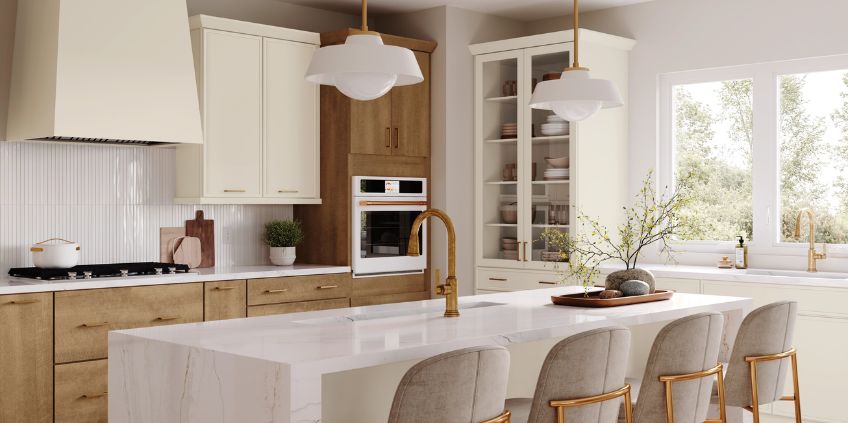
Wood and white cabinets are both strong choices — and the fact that they're now running neck and neck in the market reflects just how well both hold up. Wood brings warmth, texture, and a quality that feels very much in step with where kitchen design is heading. White brings clarity, brightness, and a timeless versatility that has earned its reputation over decades.
The right choice isn't determined by what's trending. It's determined by your kitchen — the light it gets, the way you use it, and how you want to feel in it. Start there, and the decision tends to get a lot clearer.
If you'd like to explore your options with a professional, Reico Kitchen & Bath has 24 showrooms featuring real kitchen displays where you can see both finishes in context — alongside countertops, hardware, and lighting that reflect how a finished kitchen actually looks and lives. Our designers are available to help at whatever stage of planning you're in.
Read to start your kitchen remodel? Visit Reico Showroom near you or get a preview with our showroom virtual tours.
Frequently Asked Questions
Quick answers to the questions homeowners ask most when choosing between wood and white kitchen cabinets.
Are wood cabinets more expensive than white cabinets?
Not necessarily. The cost depends more on construction quality, brand, and door style than on finish alone. Semi-custom wood cabinets and painted white cabinets can be comparable quality tiers that are can also be comparable in price. Where wood can add cost is in species like walnut, which carries a higher material price than standard maple or oak.
Do wood cabinets go out of style?
Wood has been used in kitchen cabinetry for centuries and has never fully gone out of style. While it cycles in and out of prominence, the current shift is towards natural wood finishes and in particular white oak, reflecting a broader design movement toward warmth and natural materials that have staying power. That said, choosing a clean, simple shaker cabinet door style in a versatile medium tone gives you significant longevity.
What wood species is most popular for kitchen cabinets right now?
White oak is the most widely sought-after species among designers and homeowners in 2026, valued for its subtle grain, warm gray undertones, and versatility across kitchen styles. Maple remains a popular budget-friendly choice, and walnut is favored for higher-end or more dramatic interiors.
Which cabinet color is better for resale — wood or white?
Both are strong for resale. White has historically had a broader appeal across buyer demographics, making it the more optimal choice if you're selling in the near term. Wood, especially white oak, is gaining ground and in some instances is considered a premium finish. If resale is a primary concern, a two-finish kitchen that combines both can be a smart middle ground.
Do white cabinets show dirt more than wood cabinets?
Generally, yes. Painted white surfaces tend to show fingerprints, grease, and general kitchen wear more readily than wood-finished cabinets, whose natural grain helps camouflage minor marks. This is especially noticeable around cabinet pulls and near the range. High-quality paint finishes and regular wiping minimize the issue, but it's a practical factor worth weighing for busy households.
Can you paint wood cabinets white later if you change your mind?
Yes, wood cabinets can be painted — but you never want to make a decision knowing you will want to change it at some point. It is tedious process, requiring intensive preparation and significant effort in sanding, priming and finishing with a stain or paint. The effort depends heavily on the wood species and original finish. It's an option, but it important to know how much of an undertaking it is.