Bathroom renovations can be one of the most rewarding home improvement investments you make — and one of the most expensive if you're not sure where to direct your budget. The wide range of costs you'll encounter in your research isn't a mistake. A bathroom remodel can reasonably cost anywhere from $6,700 to $50,000 or more depending on scope, size, and the decisions you make along the way.
The good news is that knowing where to spend and where to save makes an enormous difference — not just to the final number, but to how your bathroom looks, functions, and holds up over time. Some elements genuinely benefit from a higher investment. Others can be handled thoughtfully on a tighter budget without sacrificing quality or style.
This guide walks you through both sides of that equation so you can approach your bathroom renovation with clarity and confidence.
How Much Does a Bathroom Remodel Cost?
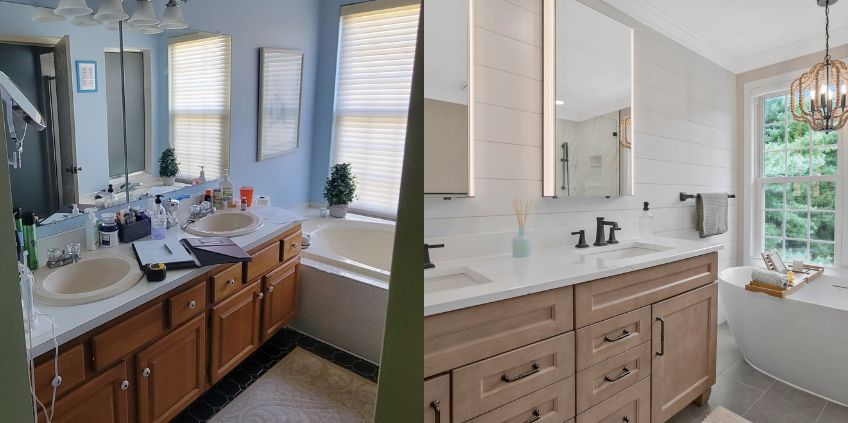
The honest answer: it depends on the scope of work, the size of the bathroom, and the materials you choose. But here are the benchmarks that matter.
According to the National Kitchen & Bath Association (NKBA), the average bathroom remodeling project costs around $12,000, with most projects falling between $6,700 and $17,600. Primary suite renovations and full gut remodels can push well beyond that range.
$12,000 average bathroom remodel cost, with most projects ranging from $6,700 to $17,600 — NKBA
To put those numbers in context, bathroom remodeling costs typically come from two sources: materials and labor. A commonly cited industry guideline is that labor runs roughly twice the cost of materials — meaning the decisions you make about layout, fixtures, and complexity have a direct and significant impact on what you'll spend.
Most bathroom projects fall into one of three scope levels, each with a different cost profile:
Light refresh ($3,000–$8,000)
Cosmetic updates that improve appearance without changing the layout. This typically includes new faucets or showerheads, updated lighting fixtures, fresh paint, new mirrors, and hardware. No plumbing or structural changes.
Mid-level renovation ($8,000–$20,000)
Replaces key features while keeping the existing layout intact. Common upgrades include a new vanity and sink, updated toilet, new countertops, and flooring or tile replacement. This is the most common remodel scope for homeowners updating a dated but functional bathroom.
Full bathroom remodel ($20,000+)
Involves significant demolition, layout changes, and full replacement of fixtures, cabinetry, and tile. May include moving or replacing the tub or shower, reconfiguring the footprint, new plumbing throughout, and custom cabinetry. Primary suite renovations often fall in this category.
Before starting your project, it's also worth setting aside 10–15% of your total budget as a contingency. Demolition regularly uncovers hidden issues — water damage, outdated plumbing, or structural repairs — that couldn't be anticipated beforehand. Having that buffer means you can address problems without derailing the project.
What Are the Most Expensive Parts of a Bathroom Remodel?
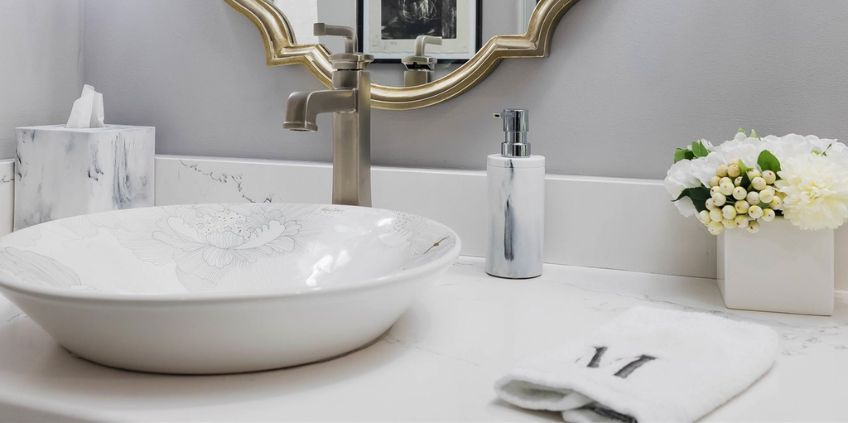
Understanding where bathroom remodel costs are concentrated helps you make smarter decisions before design begins. Here's a realistic breakdown of where the money typically goes in a mid-range bathroom renovation:
- Labor (demolition, installation, plumbing, electrical, waterproofing, tile setting): 35–50% of total project cost
- Cabinetry and vanity: $500–$3,500+ depending on whether you choose in-stock, semi-custom, or custom
- Tile (floor and walls): $3–$25+ per square foot for materials, plus installation
- Fixtures (toilet, faucets, showerhead, lighting): $500–$3,000+ depending on quality tier
- Shower or tub surround: $1,000–$8,000+ depending on materials and size
- Countertop: $200–$1,500+ depending on material and linear footage
- Mirrors, hardware, and accessories: $150–$800
Labor is consistently the largest line item — and the one homeowners most frequently underestimate when building an initial budget. Because installation costs tend to run about twice the material cost, any decision that adds complexity to the installation (layout changes, specialty tile patterns, custom shower configurations) has a multiplying effect on your overall spend.
Where Should You Save on a Bathroom Renovation?
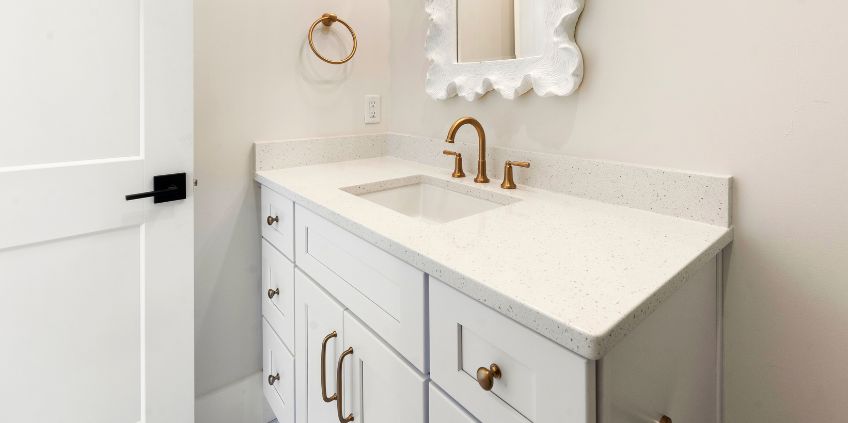
Smart budgeting doesn't mean cutting corners — it means knowing which decisions have a smaller impact on long-term performance and directing your savings there. Here are the areas where thoughtful choices consistently deliver strong value without sacrificing quality.
1. Keep the existing layout
This is the single most effective way to manage labor costs in a bathroom remodel. When plumbing fixtures stay in their current locations, you avoid the cost of rerouting supply and drain lines — work that requires a licensed plumber and adds meaningfully to your budget. If your bathroom's layout functions reasonably well, updating the finishes, fixtures, and surfaces within the same footprint can produce a dramatic transformation at a fraction of the cost of a full reconfiguration.
The savings can touch more of the budget than most homeowners expect. "Keeping the layout the same offers the most cost savings because it has the potential to reduce costs across multiple categories — plumbing, electrical, construction, and flooring," adds Reico Charlotte, NC designer Ashley Hathaway.
74% of Reico design experts identified keeping the existing layout as the best way to save money on a bathroom remodel.
2. Choose in-stock cabinetry and vanities
In-stock and semi-custom vanities offer an excellent balance of quality, design, and value. Today's in-stock options include a wide range of styles, finishes, and configurations — including floating vanities, double sink options, and integrated storage solutions — at significantly lower price points than fully custom cabinetry.
"Choosing a value-focused cabinet line allows customers to refresh the look and feel of their bathroom without overspending, making it a smart area to cut costs while still achieving a great result," says Reico Winchester, VA team member Jillian Miserak. For most bathrooms, an in-stock vanity priced between $500 and $1,500 delivers strong design impact without the lead time or premium cost of custom work.
View Reico Kitchen & Bath In-Stock Offers →
3. Select durable, cost-effective materials
Porcelain tile remains one of the best value materials in bathroom design — durable, water-resistant, low-maintenance, and available in a wide range of styles including convincing stone and wood looks. For countertops, solid surface and cultured marble offer practical, affordable options that perform well in wet environments. Quartz is a step up in cost but delivers excellent durability and minimal maintenance for homeowners who want a premium feel at a mid-range price.
The key is choosing materials that combine durability with timeless design. Trendy materials and finishes can date quickly and cost more to replace — a neutral porcelain tile that looks great today will still look great in fifteen years.
4. Keep cosmetic updates simple and strategic
Sometimes the biggest visual impact comes from the simplest changes. Swapping outdated hardware, replacing a mirror, updating a light fixture or layer lighting can refresh a bathroom dramatically without major construction. If your existing tile, vanity, and layout are in good condition, a cosmetic refresh may be all you need — and it can often be completed in a few days rather than a few weeks.
Where Is It Worth Spending More on a Bathroom Remodel?
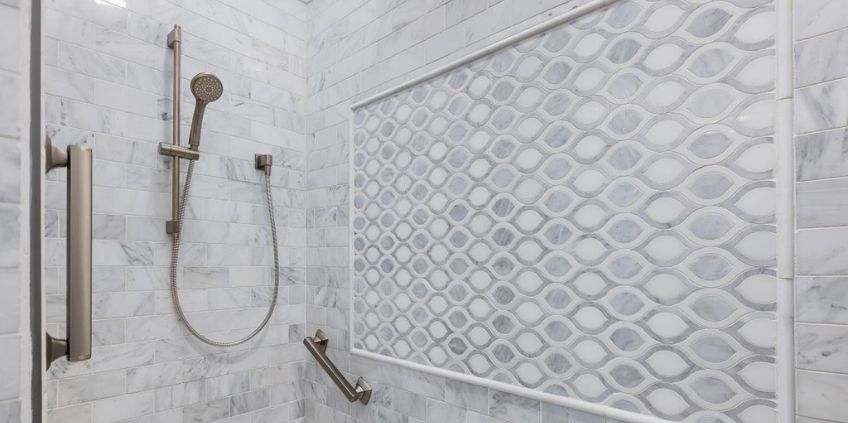
While smart savings are available in several areas, other elements of a bathroom renovation genuinely benefit from a higher investment — both for performance reasons and because cutting costs here tends to create problems that are expensive to fix later.
1. Quality fixtures used every day
Toilets, faucets, showerheads, and lighting are things you interact with multiple times a day, every day. Investing in well-made, durable fixtures pays off in reliability, water efficiency, and longevity — but it also does something less obvious. "Spending on fixtures is a no-brainer," says Erin Bucia Reico Springfield, VA designer. "By using high-end fixtures, it can make inexpensive tile look like you spent money on that too." The fixtures set the tone for everything around them.
The risk of going the other direction is just as real. Reico Milsboro, DE designer Jess Morton puts it plainly: "You can have beautiful tile, cabinets, and countertops — but when you go with cheap, low-end plumbing and fixtures, it cheapens the appearance of the space you're trying to upgrade. Low quality plumbing also means higher risk of leaks and issues down the road. A faulty faucet that leaked? Now your new vanity needs to be replaced too." Quality fixtures aren't just an aesthetic choice — they protect the rest of your investment.
Look for fixtures that carry WaterSense certification from the EPA, which ensures meaningful water efficiency without sacrificing performance. Water-efficient toilets and showerheads can reduce water usage by 20% or more compared to older fixtures — a real savings over time.
2. Professional installation for technical work
Bathroom remodeling involves several trades where proper installation is critical: plumbing connections, waterproofing systems, tile installation in wet areas, and electrical work. These aren't areas where cutting costs on labor delivers lasting value — they're the areas where improper installation leads to the most expensive problems down the road.
Water damage from failed tile waterproofing, mold behind improperly sealed shower surrounds, or fixture failures from incorrect plumbing connections are all significantly more costly to repair than professional installation would have been. If you're considering DIY to save money, the lower-risk candidates are cosmetic tasks: painting, hardware replacement, mirror installation, or accessory updates. Technical work involving water, plumbing, or electrical systems is almost always worth hiring a professional.
3. Proper ventilation
An undersized or poorly positioned exhaust fan is one of the most commonly overlooked bathroom investments — and one of the most consequential. Inadequate ventilation is a leading cause of mold, mildew, and long-term moisture damage in bathrooms. Upgrading to a properly rated exhaust fan (sized to the cubic footage of the space) is a relatively modest cost — typically $150 to $400 installed — that protects the long-term condition of your tile, cabinetry, and walls.
4. Waterproofing in wet areas
Any surface in or adjacent to a shower or tub needs proper waterproofing behind the tile — not just water-resistant drywall, but a dedicated waterproofing membrane. This is one of the most important investments in a bathroom remodel and one of the least visible. Skipping or underinvesting in waterproofing is one of the most common causes of significant structural damage in renovated bathrooms. It should be treated as non-negotiable, not as a line item to reduce.
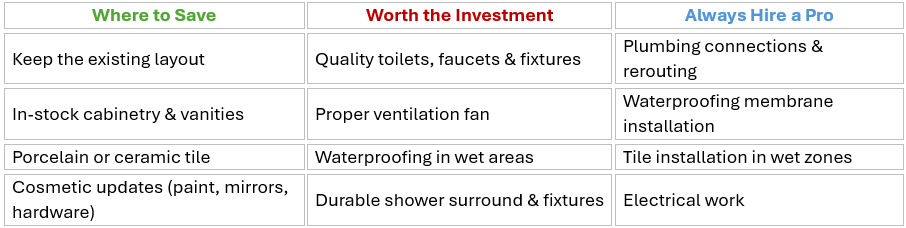
Save vs. Splurge: A Quick Reference
Here's a summary of where to direct your budget in a bathroom renovation:
What Bathroom Remodeling Mistakes Should You Avoid?
Even well-planned projects can run into avoidable problems. These are the mistakes that show up most consistently — and that good planning and professional guidance tend to prevent.
- Moving plumbing without a clear reason. Relocating a toilet, sink, or shower is one of the fastest ways to escalate a bathroom remodel budget. If the move significantly improves function or layout, it can be worth it. If it's primarily aesthetic, the cost-benefit rarely adds up.
- Choosing trendy materials over durable ones. A tile or fixture that looks fresh today may feel dated in five years. Prioritize materials with proven durability and timeless appeal, and use more expressive choices as accents rather than primary surfaces.
- Underestimating lighting. Bathrooms need layered light: ambient overhead, task lighting flanking the mirror, and ideally some accent lighting. A single overhead fixture — even an attractive one — rarely provides adequate light for grooming tasks and makes the space feel flat.
- Skipping professional installation for complex work. As covered above, the technical elements of bathroom renovation — waterproofing, tile in wet zones, plumbing, electrical — are areas where professional installation is a genuine investment, not just a cost.
- Not planning for contingencies. Hidden issues are common in bathroom demolition. Budget for them from the start rather than treating them as a surprise.
Pro Tip: Before finalizing your design, ask your contractor or designer to walk you through the sequence of work — what gets done in what order, and where the decision points are. Understanding the process helps you make better choices and catch potential issues before they become expensive ones.
Still deciding where to invest? Book a design consultation with a Reico designer →
How Do You Balance Budget and Style in a Bathroom Renovation?
A successful bathroom renovation isn't about spending as little as possible — it's about spending where it matters most. Keep your layout when you can, choose durable materials that won't need replacing in five years, invest in quality fixtures and professional installation for technical work, and build a realistic contingency into your budget from day one.
That framework applies whether you're doing a $7,000 cosmetic refresh or a $30,000 primary suite renovation. The principles are the same: prioritize function and durability, be strategic about where you save, and don't cut corners on the work that protects your bathroom's long-term performance.
At Reico Kitchen & Bath, our designers work with homeowners across all budget levels to make those decisions with clarity. From helping you find the right in-stock vanity to planning a full primary bathroom renovation, we're here to make the process feel manageable — not overwhelming.
Frequently Asked Questions
Quick answers to the questions homeowners ask most about bathroom remodel budgets and costs.
What is the most expensive part of a bathroom remodel?
Labor is consistently the largest cost in a bathroom renovation, typically accounting for 35–50% of the total project budget. Within labor, plumbing, tile installation, and waterproofing tend to be the most significant line items. Among materials, the shower or tub surround and cabinetry are usually the highest individual product costs.
Is it cheaper to remodel a bathroom yourself?
For some tasks, yes. Painting, hardware replacement, mirror installation, and accessory updates are reasonable DIY candidates that can save meaningful money. For technical work — plumbing, electrical, waterproofing, and tile installation in wet areas — professional installation is strongly recommended. Errors in these areas are costly to repair and can lead to water damage, mold, or failed inspections. The savings from DIY on complex work rarely outweigh the risk.
How much should I budget for a bathroom vanity?
In-stock vanities typically range from $400 to $1,500 for standard sizes and styles, making them an excellent value for most renovation budgets. Semi-custom options run $1,500 to $4,000, offering more size flexibility and finish options. Fully custom cabinetry starts around $5,000 and can go significantly higher. For most homeowners, a well-chosen in-stock or semi-custom vanity delivers strong design results without the premium cost of custom work.
How long does a bathroom remodel take?
A cosmetic refresh with no plumbing or layout changes can often be completed in three to seven days. A mid-level renovation replacing fixtures, tile, and cabinetry typically takes two to four weeks. A full bathroom remodel involving layout changes, custom tile work, and new plumbing can run four to eight weeks or longer, depending on material lead times and contractor scheduling.
Does a bathroom remodel add value to your home?
Yes. According to the National Association of Realtors, bathroom remodels consistently rank among the home improvement projects with the strongest return on investment. A well-executed mid-range bathroom renovation typically returns 60–70% of its cost at resale, and in competitive markets, updated bathrooms can be a meaningful factor in a buyer's decision. Choosing timeless materials, quality fixtures, and a clean, functional layout maximizes that return.
What should I not forget when planning a bathroom remodel?
Ventilation is the most commonly overlooked element — an undersized exhaust fan leads to mold and moisture damage over time. Storage planning is a close second; it's much easier to build in recessed niches, medicine cabinets, or tower storage during the renovation than to add them afterward. Lighting layers (overhead ambient, task lighting at the mirror, and accent) are also frequently underplanned. And always budget a 10–15% contingency — hidden issues during demolition are common, and having that cushion keeps the project on track.