They walked into the consultation excited. They loved the design. Then you presented the number — and the energy in the room shifted.
This is the moment that defines more client relationships than any design decision ever will. Material costs are up, labor is tight, and the gap between what a well-executed kitchen or bathroom actually costs and what clients expect to pay has never been wider. They're not being difficult. Most of the time they're working from outdated information — HGTV budgets, national average estimates that don't apply to their project, or price memory from a renovation their neighbor did five years ago. Remodeling costs have moved materially — the 2025 Cost vs. Value Report shows kitchen remodel costs are up more than 21% over five years — and clients are often quoting you a number that no longer reflects the market. When their reference point is wrong, an accurate quote looks expensive rather than correct.
At Reico, we help our trade partners navigate these conversations every day. We've seen what works — what keeps a client in the room, what gets a project back on track when budget reality hits, and what protects a professional's standing when a client comes back with a lower quote from somewhere else.
This article covers how to present pricing so it lands right the first time, how to handle quote shopping without discounting your value, and how to bridge the gap when a budget doesn't match the vision
What Does a Kitchen or Bathroom Remodel Actually Cost — and Where Does the Money Go?
The single most useful thing you can put in front of a client before presenting a quote is a breakdown of where the money goes. Not the total — the breakdown. When a client understands that cabinetry alone is typically 35–45% of a kitchen remodel, a $50,000 quote stops feeling arbitrary and starts feeling like a math problem. And math problems can be worked with.
Here's what a mid-range to upper-mid kitchen renovation actually looks like, category by category:
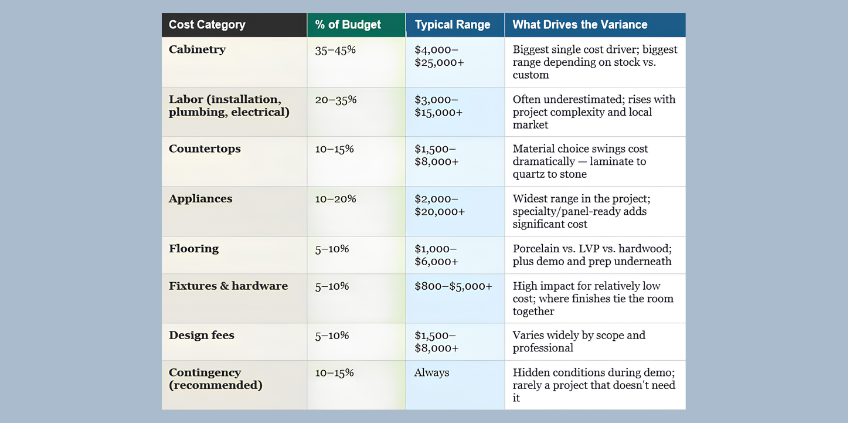
Two things in this breakdown stand out in ever pproject. Labor is the second-largest cost in most remodels and the one clients most consistently underestimate when comparing quotes. A quote that comes in lower because it uses cheaper labor or eliminates licensed trades isn't a better deal. It's a different project.
The contingency line isn't optional padding. Demolition reveals things like old plumbing, water damage, outdated wiring, and structural issues in almost every project. Clients who skip the contingency don't avoid those costs. They just discover them as a crisis instead of a plan.
How Do You Present Pricing to a Client Without Losing Them?

Most pricing conversations go wrong before the number is even said. The way you frame a quote — what you lead with, how you sequence it, whether you give the client context or just a total — determines how they receive it. Trade professionals who present pricing well close more projects at better margins, not because they charge less, but because clients understand what they're buying.
Show them what it buys before you show them what it costs
Before you reveal the total, walk through the design, the materials, the quality of construction, the professional execution behind every line item. By the time they see the number, they should already feel the value — as opposed to trying to calculate it after the sticker shock.
"Let me walk you through what's included before we look at the investment. We've specified [cabinet line] with plywood box construction, [countertop material], [fixture brand], and professional installation throughout. This is a project designed to last twenty years and add real value to your home. Now let me show you where we land financially..."
Introduce ranges early, specifics later
Where possible, put a price range on the project before selections are finalized. A client who hears '$45,000–$60,000 for a project like this' during the design phase is far better prepared for the final number than one who receives a $52,000 quote cold. Ranges also create natural room for scope conversations without them feeling like negotiations.
A breakdown is a conversation — a total is a verdict
A single large number is hard to engage with. A breakdown by category gives clients something to think alongside. Presenting cabinetry, labor, countertops, and fixtures as separate line items turns the pricing conversation into a collaborative one — and gives both of you somewhere to work if adjustments are needed.
Present three scenarios at different investment levels: the full scope as designed, a value-adjusted version with specific substitutions, and a phased option. Options feel like partnership. A single number feels like a verdict
How Do You Respond When a Client Says They Got a Lower Quote?
A client comes back with a quote that's 20% lower from someone else. Suddenly you're defending your price instead of your work. This is the moment that tests professional confidence more than almost any other. The way you handle it in the first thirty seconds determines where the conversation goes.
The most important thing to remember going in: not all quotes are quoting the same project. Lower quotes frequently reflect different materials, subcontracted labor with less oversight, excluded scope, or a contractor who underbid the work and plans to recover the gap through change orders. That doesn't make the lower quote dishonest. It makes it different. And your job is to make that difference visible.
Ask about it before you defend against it
"I'd be happy to talk through the difference. Can you share what's included, or walk me through the line items? The most common reasons for a significant price gap are differences in material specifications, how labor is structured, or what's explicitly in scope. Once we understand what we're comparing, we can have a real conversation about where the value is."
This positions you as the professional helping the client make an informed decision — not the one who feels threatened by a competitor's number. It also buys you the information you need to make the comparison specific rather than defensive.
Make the differences concrete, not abstract
If the lower quote uses a different cabinet line, name it and explain the construction difference. If it doesn't break out licensed labor, ask what trades are actually included. If it's a GC managing subs without a clear oversight structure, ask about warranty and accountability. Walk the client through what each decision means for the finished project — not to knock the competition, but to make the comparison honest.
"The quote you're looking at uses [different specification]. Here's what that means for the finished product and how the project runs day to day. Our quote uses [your specification]. That's not a minor distinction. I want you to know what you're choosing between — not just which number is lower."
Know when to hold and when to walk
Not every price objection is a negotiation. Some clients are genuinely trying to reconcile a budget that doesn't match the project. Others are looking for validation that the price is safe to take. Know which situation you're in — and know which ones are worth adjusting scope for versus which ones are telling you something about the client relationship.
Discounting your price without reducing scope sends one message to a client: your original price wasn't real. Once you establish that your quotes are negotiable, every future quote becomes a starting position. Scope adjustments are legitimate. Pure price cuts are a professional risk.
How Do You Bridge the Gap When a Client's Budget Doesn't Match Their Vision?
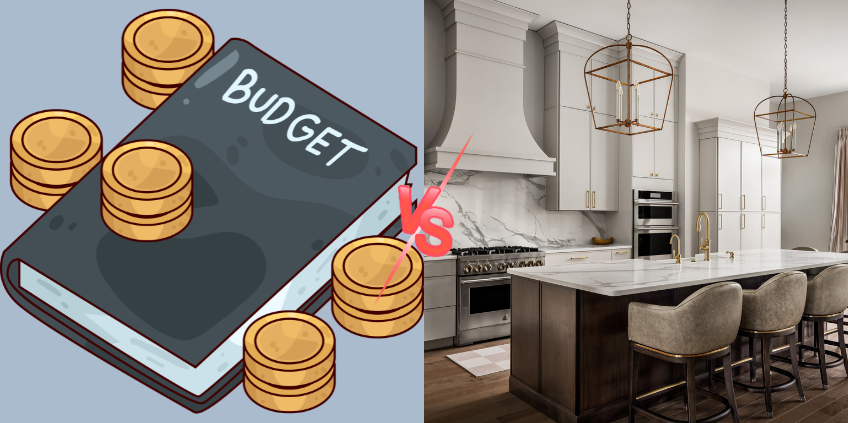
This is the version of the pricing conversation with the most room to work — and the one that most often turns a difficult moment into a stronger client relationship. A client who loves the design but can't fund the full scope isn't a lost project. They're an invitation to show what it looks like to work with a professional who actually listens.
Start by asking what's non-negotiable
Clients almost always present everything as essential — but the reality is that most renovation wish lists have a short list of non-negotiables and a longer list of preferences they've never been asked to rank. One question changes the conversation completely:
"If you had to choose three things about this project that you absolutely couldn't live without — the things that, if we didn't do them, the renovation wouldn't feel worth it — what would they be? That tells us exactly where to protect the budget and where we might have room to move."
Most clients find this question clarifying rather than frustrating. It gives them direction in a conversation that otherwise feels like someone is taking things away from them.
Offer specific substitutions, not vague cuts
The worst version of this conversation is a vague offer to 'value engineer' the project. The best version is a specific trade-off with a real number attached: 'If we move from the semi-custom cabinet line to this in-stock option, we save $4,500, and in your layout the visual difference is minimal. Here's what that actually looks like.' Specific substitutions feel like design decisions. Generic cuts feel like settling.
When you’re getting ready for that conversation, it’s just easier if you already have a few solid options in your back pocket. Reico's in-stock cabinet lines and current cabinet promotions are great to pull from in the moment—not something you want to go hunting for afterward.
Phasing is a real option, not a consolation prize
Some projects are genuine candidates for phasing — the kitchen now, the primary bath in 18 months; the full layout now, the appliance upgrades when the budget recovers. Phasing lets clients start the project they can fund today without abandoning the vision for later. The critical rule: design for the full scope from the beginning. Phase one and phase two should feel like one continuous project, not two separate ones that have to be reconciled.
Phasing works best when it's planned, not improvised. If a client's budget suggests phasing is likely, design the full project first and then identify the phase break — don't design phase one in isolation and figure out phase two later.
Be straight when the numbers don't work
The most valuable thing you can do is be direct: the budget and the vision aren't the same project. Said early and specifically, that honesty earns trust. Said late — through change orders or a result that disappoints — it costs you a client and a referral.
"I want to be straight with you, because I think you deserve an honest answer rather than a version that's been adjusted to fit a number. The project as we've designed it is [X]. At your current budget, here's what we can do well: [specific scope]. That's a real project — but it's a different one. I'd rather have this conversation now than have you discover the gap during construction."
Clients who hear this almost always respond with more respect, not less. You may not close the project today. But you will be the first person they call when the budget is ready — and the person they send their friends to in the meantime.
The Takeaway: The Pricing Conversation Is a Trust Conversation
The clients who feel burned by a remodeling project almost never feel that way because the project cost too much. They feel that way because the cost surprised them — because the gap between what they were told and what they experienced wasn't managed honestly from the start.
Trade professionals who navigate pricing well aren't the ones with the lowest quotes. They're the ones who educate clients before the number lands, present breakdowns instead of totals, offer real options when adjustments are needed, and are direct when a budget and a vision aren't compatible. That approach doesn't win every project. It wins the right ones — and it builds a practice that grows on referrals instead of discounts.
At Reico, we help our trade partners find product solutions that work across all budget levels — from in-stock cabinet and vanity lines that deliver strong value to full semi-custom and custom specifications for clients with the budget to match their vision. When a client's budget needs to flex, having the right options on hand makes the conversation easier. Reach out to us and we'll help you work through it.