Most homeowners shopping for a bathroom vanity start with color, style, and size. Those decisions matter — but they aren't what determines whether your bathroom still looks great after years of everyday use. The material underneath the finish is what decides that.
Bathrooms are some of the most demanding spaces in a home. With constant humidity, daily temperature changes from hot showers, standing water, foot traffic, and exposure to cleaning products — the wrong material in that environment doesn't fail gracefully. It warps, swells, peels, cracks, or discolors, often years before you planned to remodel again. And when that happens, it's rarely a quick fix.
At Reico Kitchen & Bath, our designers work with homeowners every day to select materials that actually perform — not just in the showroom, but in a real bathroom under real daily use. We've seen firsthand which choices hold up and which ones quietly disappoint over time.
This guide covers every major surface in your bathroom — flooring, walls, countertops, cabinetry, fixtures, and more — so you can make decisions built on function, not just appearance.
What Are the Most Durable Materials for Each Bathroom Surface?
Before diving into the details, here’s a clear, skimmable snapshot of the best material choices for each major bathroom surface—along with moisture performance, maintenance needs, and approximate installed cost ranges. Use it as a planning checklist as you work through your remodel decisions. Just remember that costs can vary by market.
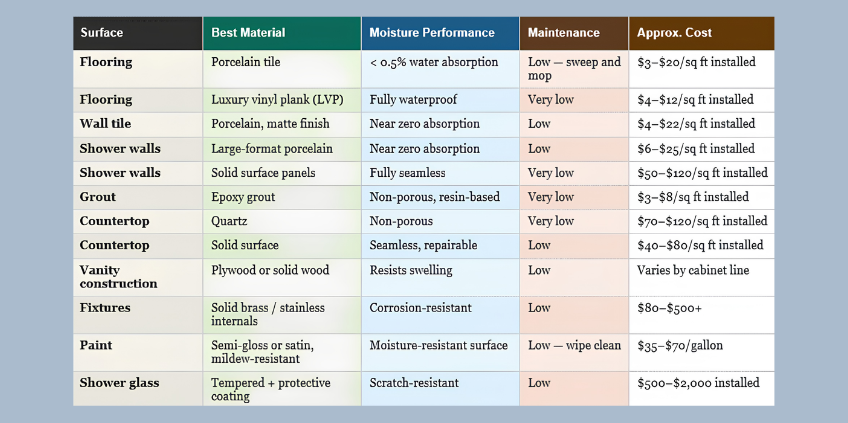
The sections below explain the reasoning behind each recommendation, including what goes wrong with lower-performing alternatives and how each material behaves under real daily use.
What Flooring Holds Up Best to Daily Bathroom Moisture?
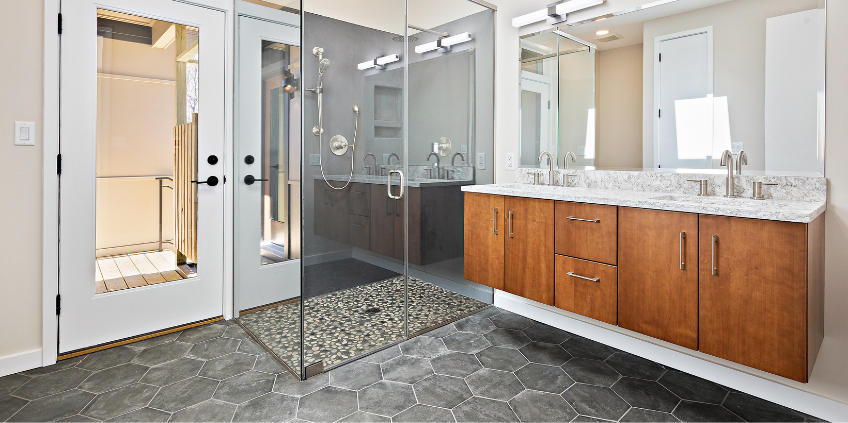
Start with the floor. It takes more water contact than almost any other surface in the bathroom — standing puddles, wet feet, daily mopping — and porcelain tile handles that better than anything else on the market. It absorbs less than 0.5% water, compared to ceramic's higher absorption rate, which is why it holds up longer to cracking, staining, or warping over years of use.
The difference comes down to density. Porcelain is fired at higher temperatures than ceramic, producing a denser tile that resists moisture penetration, chipping, and cracking more effectively over time. In a bathroom that sees heavy daily use — kids tracking in wet feet, regular mopping, puddles around the tub — that density translates to a floor that still looks and performs well years later.
Luxury vinyl plank (LVP) is a strong second choice, particularly for households that want a warmer underfoot feel or a tighter budget. Modern LVP is fully waterproof, comfortable to stand on, and much easier to install than tile. For a mid-range bathroom remodel, it performs well without the cost of large-format porcelain.
Natural stone — marble, travertine, and slate — is genuinely beautiful underfoot but requires annual sealing to maintain water resistance. Without consistent maintenance, natural stone can absorb moisture, stain, and develop cracks from freeze-thaw cycles in unheated spaces. If you love the look of stone, porcelain tile now replicates it convincingly with none of the upkeep.
What Wall Materials Resist Mold and Moisture in a Bathroom?
Shower walls take more direct, sustained water exposure than any other surface in the bathroom — and the material you choose there matters more than most homeowners expect. Large-format porcelain tile is the strongest choice because its near-zero water absorption keeps moisture out, and fewer grout lines means fewer places where water can eventually get behind the tile.
Shower walls face more sustained water exposure than any other surface in the bathroom. The key performance factor isn't just the tile itself — it's what's behind it. Mold-resistant cement board or a dedicated waterproofing membrane behind the finish layer is essential. Standard drywall, even moisture-resistant varieties, isn't adequate in a shower enclosure. Skipping this step is one of the most common causes of structural damage in renovated bathrooms.
Solid surface panels — large-format panels made from acrylic or polyester composite — are gaining popularity as a shower wall alternative because they're completely seamless. No grout lines means no pathways for water intrusion, and the material is non-porous and easy to clean. The tradeoff is cost: solid surface panels typically run $50–$120 per square foot installed, compared to $6–$25 for porcelain tile.
Reico Springfield, VA designer Dave Wilhide, says “When it comes to spending, it really comes down to personal preference. Focus your budget on the things that matter most to how you use your bathroom, and let those be the higher end choices. You can still find great looking, high quality options at lower price points. And don’t forget to consider materials that support aging in place—those decisions pay off long-term.”
For non-shower bathroom walls — the area above a wainscot or behind a vanity — vinyl wall coverings and high-quality semi-gloss paint are practical, moisture-resistant options. Ceramic tile also works well in these lower-exposure areas and is generally more forgiving than porcelain for walls where moisture impact is less severe.
Glass shower enclosures are durable and straightforward to clean, but their long-term performance depends heavily on installation quality. A frameless glass enclosure eliminates the metal framing that's most prone to corrosion and mold along the seals — making it the more durable option over time compared to heavily framed alternatives.
Pro Tip: Large-format tiles (24x24 and above) on shower walls aren't just a design trend — they're a durability decision. Fewer grout lines mean fewer points of potential water infiltration behind the tile. If your shower design can accommodate large-format tile, it's worth considering for performance reasons alone.
What Type of Grout Resists Mold Best in a Bathroom?
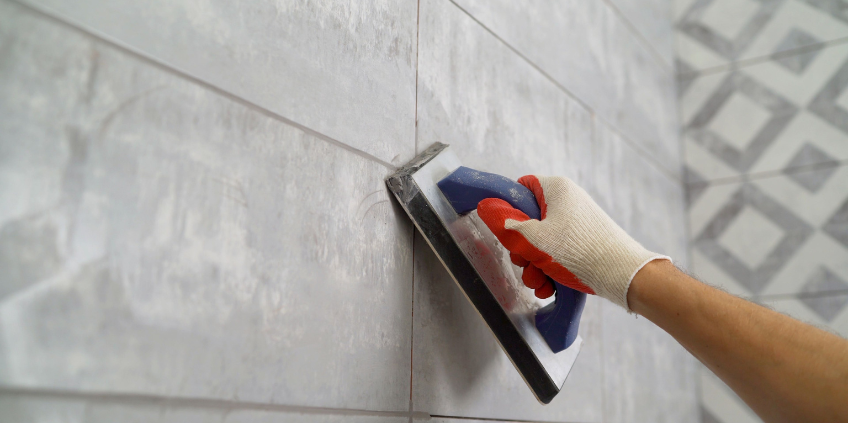
Grout gets overlooked in most material conversations, but it's often the first thing in a bathroom to fail. The reason is simple: traditional cement grout is porous. It absorbs water, soap residue, and body oil, which creates the conditions for mold and discoloration even in bathrooms that are cleaned regularly. Epoxy grout doesn't have that problem — it's resin-based, not cement-based, which means it doesn't absorb anything.
The tradeoff is installation. Epoxy grout costs more than cement grout and is considerably more technical to install — it sets fast, requires precise mixing, and doesn't forgive slow work. This is one place where professional installation pays for itself. An improperly installed epoxy grout job is harder to correct than a cement grout one.
Caulking and sealants are equally important and often overlooked. Anywhere two surfaces meet — tile and tub, tile and shower pan, tile and vanity — needs a proper flexible sealant rather than grout. Grout is rigid and will crack at those transitions over time. A quality silicone caulk that's inspected and replaced every few years prevents the water intrusion that causes the most serious long-term damage.
If your budget or project scope calls for traditional cement grout, choosing a darker color is a practical compromise. It won't prevent staining, but it will hide the inevitable discoloration that develops with regular use.
What's the Most Durable Countertop Material for a Bathroom Vanity?
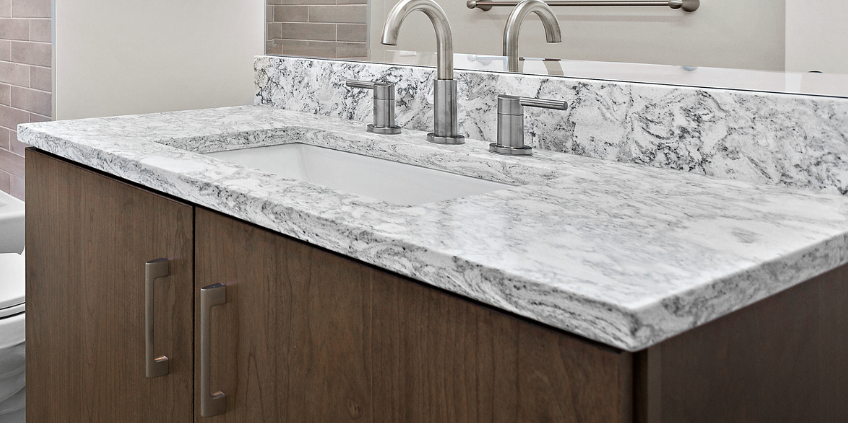
Quartz is the countertop material our designers recommend most often for primary bathrooms, and the reason isn't just aesthetics — it's practical. A vanity surface faces toothpaste, makeup, perfume, hair products, and water every single morning. Quartz is non-porous, so none of that absorbs into the surface. It resists stain, it doesn't etch, and it doesn't need sealing. For a surface that takes that kind of daily use, that matters.
The gap between quartz and marble becomes clear pretty quickly in real life. Marble looks beautiful, but it's a natural stone with tiny pores that absorb liquids. Everyday bathroom products — toothpaste, citrus-based cleaners, perfume with alcohol — can etch the surface and leave dull spots that won't polish out. Granite performs better than marble but still needs regular sealing. Quartz needs neither, which is why it's the lower-maintenance choice for a bathroom that gets real use.
Solid surface countertops — brands like Corian — are worth considering as a mid-range alternative. They're completely seamless (the sink can be integrated into the surface with no caulk joint), non-porous, and can be sanded and repaired if scratched. The vulnerability is heat: styling tools left directly on solid surface can leave marks. If heat tools are part of your daily routine, quartz's heat resistance makes it the stronger choice.
Terrazzo is worth knowing about if you want something distinctive. A mixture of marble chips, quartz, glass, or other aggregates set in cement or resin, it's extremely hard-wearing and comes in a wide range of colors and patterns. Cement-based terrazzo requires sealing; resin-based terrazzo is non-porous and easier to maintain. Both hold up well in bathroom environments and tend to improve visually with age.
For homeowners who love the look of marble, using it in a lower-use area — a powder room that gets occasional use rather than a primary bath — is a reasonable compromise. The sealing and maintenance commitment is more manageable in a space that isn't used every day.
What Makes Bathroom Cabinetry Hold Up to Moisture and Daily Use?
Plywood cabinet box construction holds up better than MDF or particleboard in bathroom humidity. Plywood's cross-layered grain structure better resists swelling and warping when exposed to moisture — a failure mode that can be permanent once it starts.
MDF and particleboard are made from compressed wood fibers that readily absorb moisture once the surface finish is compromised — through a chip, a worn seam, or condensation around the sink. Once those materials swell, they don't recover. Plywood resists that because alternating grain layers work against each other's tendency to expand. It holds its shape.
When evaluating a vanity, look beyond the door style and finish. Ask what the cabinet box itself is constructed from. A beautiful shaker-style door on a particleboard box is a combination that the door will outlive — not because the door is exceptional, but because the box underneath it can deteriorate faster over time. Quality joinery, water-resistant interior finishes, and soft-close hardware are the additional markers of well-built cabinetry.
For guidance on the full range of vanity decisions — size, storage type, sink configuration, and style — see our complete guide to choosing a bathroom vanity.
What Plumbing Fixtures Won't Corrode or Leak?
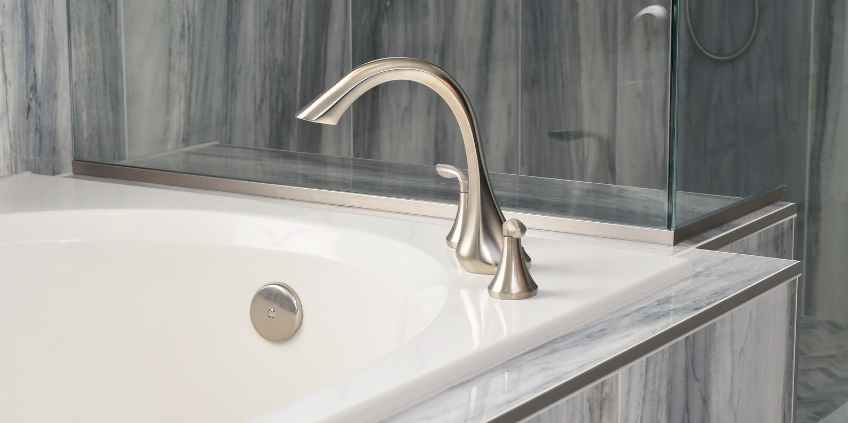
Here's something most fixture shopping misses: the finish you see on the outside of a faucet isn't what determines how long it lasts. The internal valve and cartridge are. Fixtures built with solid brass or stainless steel internals resist corrosion far better than those with zinc alloy or plastic components — and that difference is what separates a fixture that works well for fifteen years from one that starts leaking in three.
It's easy to focus on what a faucet looks like — brushed nickel, matte black, unlacquered brass. But the internal valve and cartridge are what wear out. Solid brass and stainless steel resist the constant water exposure inside a faucet far better than zinc alloy (which corrodes) or plastic (which cracks under temperature cycling). Lower-cost fixtures with those interior materials tend to develop leaks, reduced water pressure, or handle failure within just a few years.
A failed internal cartridge or valve isn't just a dripping faucet. If the leak goes unnoticed for weeks or months, the damage extends to the cabinetry and flooring beneath it — and that repair costs far more than the fixture itself ever would have. Better internals aren't just a quality upgrade. They protect everything around them.
When shopping for fixtures, look for manufacturers who publish internal construction details in their product specifications. A reputable manufacturer will typically list the cartridge and valve materials. If that information isn't available, it's worth asking — or choosing a brand with a track record.
What Paint Holds Up Best in a Humid Bathroom?
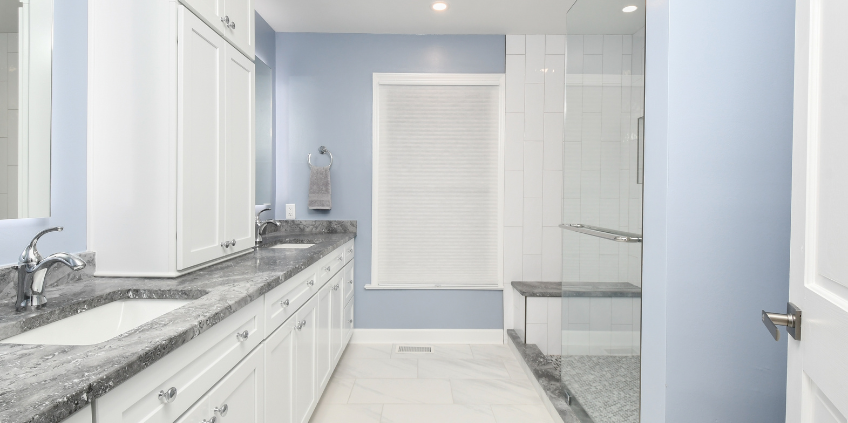
Semi-gloss or satin paint with a mildew-resistant formula holds up best in bathrooms. The sheen level isn't just an aesthetic decision — it's a performance one. Semi-gloss and satin finishes have a smoother, less porous surface than flat paint, which means steam and moisture bead and run off rather than soaking in.
Flat and matte paints absorb moisture more readily, which accelerates peeling and creates conditions where mold can develop on the surface — particularly in bathrooms with limited ventilation. Even with regular cleaning, flat paint on bathroom walls tends to show wear significantly faster than a semi-gloss or satin application.
Many paint manufacturers now offer dedicated bathroom formulas with mildew-resistant additives built in. They cost a little more than standard interior paint and are worth it — particularly in bathrooms that run humid. Surface preparation matters just as much: clean, primed walls hold paint better and longer than applications over unprepared drywall or previously peeling surfaces.
For bathrooms with ventilation challenges, mold-resistant paint adds a genuine layer of protection. It won't substitute for a properly sized exhaust fan, but it reduces the risk of mold growth on painted surfaces between cleanings.
Are There Eco-Friendly Bathroom Materials That Are Also Durable?
The short answer is yes — and more often than you'd expect, the sustainable choice and the durable choice are the same thing.
Recycled glass tile is a good example. Made from post-consumer glass, it's non-porous and handles moisture as well as ceramic tile does. It works particularly well as an accent in a shower or as a backsplash — the depth of color you get from recycled glass is something you don't see in standard tile, and the material itself is genuinely tough.
Quartz countertops are already the top durability pick in this guide, and they're also one of the more sustainable countertop options. They're made from abundant materials, they don't need sealing (which means no ongoing chemical use), and they last decades without needing replacement. Compare that to natural stone, which requires quarrying and annual chemical sealing, and the environmental math is pretty straightforward.
Bamboo cabinetry is worth considering if you want something different and sustainable — bamboo reaches usable size in three to five years, compared to decades for hardwood. But it comes with a real caveat: bamboo needs to be properly sealed and it performs best in well-ventilated bathrooms. Untreated bamboo in a consistently humid space will swell and fail the same way MDF does. If you go this route, ask specifically about the moisture treatment before committing.
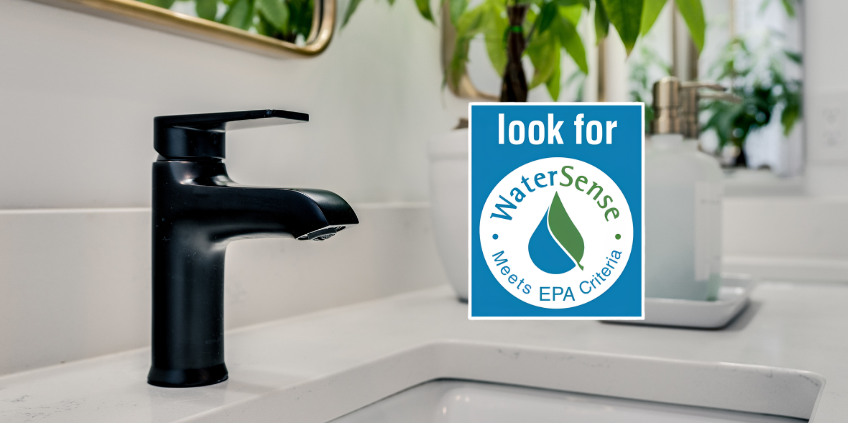
WaterSense-certified fixtures reduce water consumption by 20% or more without any sacrifice in performance. If you're already investing in brass or stainless steel internals for durability, the WaterSense certification is an easy add — it doesn't cost more and it saves real money on water bills over time.
How Do You Prioritize Spending on Durable Bathroom Materials?
The most effective approach to bathroom material budgeting is putting your money where the moisture is — floors, shower walls, countertops, and fixtures — and being more cost-conscious in areas that see less daily use.
Flooring and shower walls take the most sustained water contact of any surfaces in the bathroom. Upgrading to porcelain tile in these areas — even at a higher cost per square foot than ceramic — pays off in reduced maintenance and a longer replacement cycle. The same logic applies to grout: the price difference between epoxy and standard cement grout is real, but it's far less than the cost of re-grouting a shower a few years ahead of schedule because the original grout failed.
“When it comes to spending, it really comes down to personal preference. Focus your budget on the things that matter most to how you use your bathroom, and let those be the higher end choices. You can still find great looking, high quality options at lower price points. And don’t forget to consider materials that support aging in place—those decisions pay off long-term,” explains Dave.
Countertops and cabinetry have the highest visual impact and the widest price range. Quartz at $70–$120 per square foot installed costs more than laminate ($20–$40), but no sealing requirements, scratch resistance, and stain resistance make the long-term value much stronger than the upfront number suggests. For cabinetry, the construction quality — plywood versus particleboard — often isn't reflected clearly in the price. It's worth asking specifically about box construction when comparing vanities at similar price points.
In areas with less moisture exposure — paint, mirrors, accessories, hardware — there's more room to save without affecting long-term performance. A semi-gloss paint at $40 a gallon and a quality $65 mirror will hold up comparably to options that cost three times as much.
$10,000–$20,000 is the most common range for a mid-level bathroom remodel — enough to make smart material investments in high-impact areas without a full gut renovation.
Put your money into what can't easily be changed later. Tile, cabinetry, and countertops are expensive and disruptive to replace. Mirrors, lighting, hardware, and accessories can be swapped in a weekend. That's the budget framework that holds up best in practice — and the one our designers come back to with almost every project.
How Should You Use This Guide When Planning Your Bathroom Remodel?
Keep the quick reference table handy as you work through your material decisions. For each surface — flooring, walls, countertop, cabinetry, fixtures — it gives you a clear starting point and flags where lower-performing alternatives tend to fall short.
The bottom line across every recommendation in this guide is the same: what's underneath the finish matters more than the finish itself. Color and style are easy to change later. A hardware swap or a new mirror can refresh a bathroom in a weekend. But once a particleboard vanity swells, a grout line fails, or a cheap faucet cartridge starts leaking, there's often no cosmetic fix. The only path forward is replacement — and that's the outcome good material choices are designed to prevent.
The encouraging part is that durable materials are accessible at more price points than ever. You don't have to buy at the top of the market to choose well. You just have to know what to look for — and that's what this guide is for.
For more guidance on the renovation process itself, our bathroom remodeling mistakes to avoid blogcovers the planning and installation decisions that most commonly cause homeowners to overspend or redo work — a useful companion to this materials guide.
At Reico, our designers work with homeowners across all budget levels to make these decisions with clarity. If you'd like to see materials in person — tile samples, vanity construction, countertop options — visit one of our 25 showrooms near you! We would love to guide you to making the best decision for you and your bathroom.
Ready to choose materials that last? Book a design consultation with a Reico designer!
Frequently Asked Questions
Answers to the questions homeowners ask most when choosing durable bathroom materials.
What is the most durable material for bathroom surfaces overall?
Porcelain tile is the most consistently durable material across multiple bathroom surfaces — floors, shower walls, and wall tile — because of its near-zero water absorption, hardness, and low maintenance requirements. For countertops, quartz is the most durable choice. For fixtures, look for solid brass or stainless steel internal components regardless of the visible finish.
Is natural stone always the best choice for bathroom countertops?
No — natural stone is beautiful but not the most durable choice for most bathrooms. Marble, in particular, is porous and can etch from everyday products like toothpaste and perfume. Granite performs better but still requires annual sealing. Quartz is engineered to be non-porous and requires no sealing, making it more durable and lower-maintenance than natural stone for a surface that sees daily use.
Do all types of bathroom grout require sealing?
No. Epoxy grout is resin-based and non-porous, so it does not require sealing — which is one of its primary advantages over traditional cement grout. Cement-based grout is porous and should be sealed after installation and re-sealed periodically (typically annually in wet areas) to maintain stain and mold resistance. If you're not prepared for that ongoing maintenance, epoxy grout eliminates the requirement entirely.
Can eco-friendly bathroom materials be as durable as traditional ones?
Yes — in many cases they perform comparably or better. Recycled glass tile is non-porous and as moisture-resistant as ceramic tile. Quartz countertops are both highly durable and more sustainable than quarried natural stone. WaterSense-certified fixtures deliver the same performance as standard fixtures with 20% less water use. Properly treated bamboo cabinetry can outlast lower-quality conventional wood products. Sustainable and durable are increasingly the same choice.
Which is better for bathroom floors: ceramic tile or natural stone?
For most homeowners, porcelain or ceramic tile is the more practical choice. Porcelain is denser and more water-resistant than ceramic, and both are significantly more forgiving in terms of maintenance than natural stone. Natural stone floors require annual sealing and are more vulnerable to staining, etching, and cracking from freeze-thaw cycles. If you love the look of stone, porcelain tile now replicates it very convincingly with a fraction of the upkeep.
What can I use on bathroom walls instead of standard drywall?
In wet areas like showers and tub surrounds, standard drywall — even moisture-resistant varieties — isn't an adequate substrate behind tile. Cement board or a dedicated waterproofing membrane system is the correct base layer for wet wall tile. In lower-moisture areas outside the shower, moisture-resistant drywall, ceramic or porcelain tile, high-quality semi-gloss paint, or vinyl wall coverings are all practical, durable options depending on your budget and design goals.